
Everything That Actually Works for Heartburn
A complete map of every remedy, habit, and intervention the research supports — gathered so you don't have to search alone

It took me longer than I’d like to admit.
I had heartburn for twenty years. It was simply part of my life, the way a bad knee or a difficult commute becomes part of a life. I tried things. Some worked for a while. None of them solved it, and eventually I stopped believing it could be solved.
Then my daughter said: it’s the coffee.

I heard her. I nodded. And somewhere inside I dismissed it immediately, with the kind of calm that only comes from being completely, fundamentally certain. The freshly brewed coffee every morning, the one pleasure I had never suspected, could not possibly be the culprit. I had been drinking it for twenty years without problems. And besides, I had already cut so many other things.
It was the coffee.
Blind spots are the rule, not the exception. Almost everyone who struggles with recurring heartburn has one. A habit, a food pairing, a time of day, or a stress response they have never connected to their symptoms because the link isn’t obvious enough. Triggers are remarkably individual, and the only way to find yours is to go systematically through the whole picture, not just the most obvious candidates.
That is why I gathered all of this. Not to say that one thing works. But because the thing that works for you might be the last one you would expect.
The fire shows up without warning. You finish a meal, lie down on the couch, or simply bend forward to tie your shoes — and there it is. A burning pressure climbing from your stomach up into your chest, sometimes all the way to the back of your throat. It tastes acidic. It makes you sit very still and breathe carefully. It ruins sleep and ruins evenings.
Heartburn is among the most common complaints in the northern hemisphere. Somewhere between 20 and 30 percent of adults experience it regularly. Most of them manage it alone, with whatever remedy they happen to know about. A glass of milk from their mother. An antacid from the pharmacy. Sleeping propped up on extra pillows that never quite work.
What most people don’t know is that there are dozens of evidence-supported strategies for getting rid of heartburn and keeping it away. Some are immediate. Some are structural changes that rewire the whole pattern over weeks. Some are supplements backed by good randomized trials. Some are positional, anatomical, behavioral. Taken together, they form a toolkit substantial enough that almost anyone can find a combination that transforms their experience.
I spent time gathering all of it. Not to tell you there is one answer, but because there isn’t. The research keeps repeating one humbling finding: what works depends on the person. So the most useful thing I can offer is the full picture, with enough explanation that you can identify your own leverage points.
Here is everything.
What Is Actually Happening in Your Body
Before any remedy makes sense, it helps to understand the mechanism. Heartburn is not a stomach problem. It is a valve problem.
Between your esophagus and your stomach sits a muscular ring called the lower esophageal sphincter, or LES. Under normal conditions, this valve opens when you swallow and closes immediately afterward, keeping stomach acid sealed inside where it belongs. When the LES relaxes at the wrong moment, or when pressure from below exceeds the valve’s resistance, stomach acid splashes upward into the esophagus. The esophagus, unlike the stomach, has no protective mucus lining. That unprotected tissue meeting stomach acid is what produces the burning sensation.
The clinical term for this is gastroesophageal reflux. When it becomes frequent and severe enough to affect quality of life, doctors call it GERD — gastroesophageal reflux disease. GERD is a prevalent chronic gastrointestinal disorder that affects a substantial proportion of the global population, characterized by the extensive backward flow of stomach contents into the esophagus.
Several things weaken or distract the LES: food, posture, excess weight, stress, medications, tobacco, alcohol, pregnancy, and the timing of meals relative to sleep. Most of the remedies below work by addressing one of these inputs.
Part One: When It’s Happening Right Now
Stand Up and Stay Upright
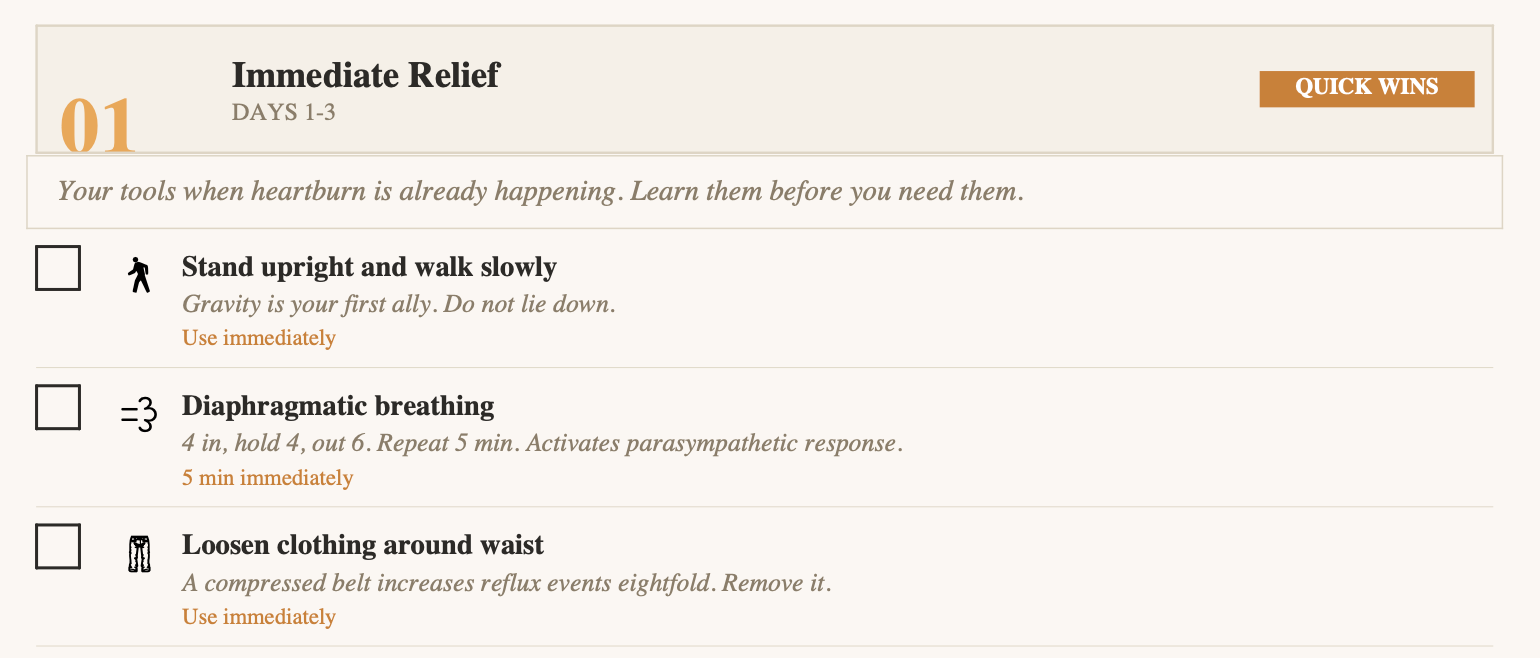
The simplest and most immediate action is also the most overlooked. Gravity is on your side when you’re standing. When stomach contents are already refluxing, lying down or even sitting slumped makes them pool against the LES and continue moving upward. Stand up straight. Resist the urge to curl into the couch. Walking slowly is even better than standing still, because movement encourages gastric emptying.
Take a Slow, Controlled Deep Breath
Some people find relief from heartburn by taking a deep breath in and bearing down while holding it. This may work because the diaphragm lowers when you take a deep inhalation, pulling the esophagus down with it. When the esophagus is slightly pulled down, it can temporarily reduce the amount of stomach acid leaking back up into it. It sounds too simple to matter. It sometimes matters.
Loosen Whatever Is Tight Around Your Waist
This is one of the most underrated immediate interventions, and the physics behind it are striking. A study published in Gastroenterology measured what happens when a belt compresses the abdomen: stomach pressure increased by about 7 mmHg while fasting and 9 mmHg after eating. That pressure difference increased acid reflux events roughly eightfold. When acid did reflux, it took 81 seconds to clear with the belt on versus 23 seconds without it. The moment you’re symptomatic, the first physical action worth taking is undoing your belt, unbuttoning the top of your trousers, or changing into looser clothes.
Chew Sugar-Free Gum
This one surprises people. In a study of 31 people with reflux symptoms, chewing gum after a reflux-triggering meal reduced the time that acid lingered in the esophagus by roughly 37%. The mechanism is clean: as we chew gum, we produce more saliva and swallow more frequently, which helps wash digestive acids from the esophagus back into the stomach. Saliva is also alkaline, which means it has the ability to neutralize the acids that cause heartburn.
Studies show a 10 to 15-fold increase in saliva flow rate during gum chewing, with esophageal acid clearance improving by 40% and esophageal pH returning to normal 50% faster after reflux episodes. One important caveat: peppermint or spearmint gum flavors can relax the lower esophageal sphincter, which may worsen symptoms. Stick to fruit-flavored or plain sugar-free gum. Bicarbonate-infused gum, available in pharmacy dental aisles, may work even better than standard gum.
Eat a Banana Slowly
Bananas are thought to help coat the lining of the esophagus with a protective layer, making heartburn symptoms less bothersome. Animal research suggests they may assist in healing ulcers as well. The effect is modest and not universal, but a ripe banana is a gentle, accessible option that a meaningful number of people find quiets the burn within 10 to 15 minutes.
Noah Frank, a writer who documented his own heartburn experience on Substack, describes realizing during the pandemic that his heartburn had completely disappeared. After months of trying to isolate the variable, he traced it to a single daily habit: eating a ripe banana. “The only times I’ve felt even a hint of heartburn returning in the last couple years,” he writes, “I’ve been able to immediately identify that I’ve gone several days without eating a banana.” He is careful to note that bananas do not work for everyone, and that for people with irritable bowel syndrome they can actually worsen symptoms. But for many, the effect is real.
Drink Low-Fat Milk
Just like many antacids, milk contains calcium that can help neutralize acidity from heartburn. Opt for skim or low-fat milk. The fat in whole milk might further upset the stomach if you already have heartburn. The relief is temporary — milk neutralizes acid on contact but can stimulate further acid secretion minutes later — but for a brief flare, a cold glass of skimmed milk can bridge the gap while a longer-acting remedy takes effect.
Take an Antacid
Over-the-counter antacids are the pharmaceutical version of what milk does, but faster and more precisely calibrated. Products containing calcium carbonate (like Tums) and those containing aluminum and magnesium hydroxide (like Maalox) both work within minutes by chemically neutralizing stomach acid. Products containing aluminum and magnesium hydroxide tend to kick in slightly faster than calcium carbonate tablets, though both provide relief within minutes. They are appropriate for occasional use. The American College of Gastroenterology notes that if you are reaching for antacids more than twice a week, you need a proper evaluation rather than continued self-treatment.
What to Avoid Right Now: Baking Soda
Baking soda is often mentioned as a heartburn remedy, and it does neutralize stomach acid. The problem is the dose required for meaningful relief edges toward dangerous territory. Consuming too much sodium or bicarbonate can be very dangerous for your health, and even fatal at high enough doses. People with high blood pressure, kidney disease, or heart conditions face particular risk. It is a remedy to approach with real caution, not a casual home fix.
What follows is the part most people never reach — because most guides stop at the obvious. The research on diet, sleep position, the gut-brain axis, supplements, and medications is where the real patterns are. If you have tried the quick fixes and they haven’t held, this is where to look.
Subscribers also receive the printable Heartburn Protocol — a complete elimination checklist you can print out and work through systematically, phase by phase, to identify exactly what is causing your symptoms. It is the structured companion to everything in this article.
